
GUEST WRITER: DEBORAH JODREY
Summer is starting, fall is right around the corner, and the youth calendar is set (or in progress). There are many great ideas for engaging youth, and leaders are evaluating how to take the plans to the next level.
Now is the time to ask, “Do these plans consider marginalized youth?”

Before diving into practical tips for doing so, I will define “marginalized youth” and help you consider why planning with them in mind is important.
Who Are “Marginalized Youth?”
The word “marginalize” was originally used to refer to writing notes in the margin of a page, the blank space surrounding a text. Around 1970, the word “marginalize” took on an additional meaning and is now understood as pushing an individual to the edges of society. Someone pushed to the margins of society often has less power, access, and opportunity as a result of cultural systems and norms that confer advantage and privilege on some groups while disempowering others.
In our current Western society, marginalized groups can include (but are not limited to):
- Black, Indigenous, and other people of color
- Queer and trans people
- People living in poverty or with limited economic resources
- Disabled or neurodivergent people
Why Is It important to Plan with Marginalized Youth in Mind?
Even with the best intentions, unless youth with marginalized identities are deliberately included, it is easy to default to the norms and systems in which we were raised and in which we currently exist.
Who youth directors have in mind when planning impacts who actually gets to participate.
The default events and activities for youth often prioritize extroverted, able-bodied, and high-energy youth (just to name a few), which means that even well-meaning activities can unintentionally exclude and isolate youth. If the goal is for all youth to know that God loves them and they belong in this community, then planning must be taken seriously. Designing with marginalized youth in mind helps us think more creatively and ask better questions (see the examples below).
Prioritizing marginalized youth is not about adding something extra; it is about designing activities and programs so that all young people can show up fully as themselves, feel valued, and participate meaningfully. When centering marginalized youth in planning, programs become more inclusive, more creative, and more fun! The entire community grows stronger.
Ensure Safety
Tip: Prioritize Safety Before Fun
Before youth can fully engage or have fun, they need to feel emotionally and spiritually safe. Safety is something many marginalized youth, especially queer youth, have not consistently experienced in church spaces. Even without intentional harm happening in your space, the history of harm and exclusion matters. Prioritizing emotional and spiritual safety means being intentional about inclusion, language, and expectations so all youth feel safe enough to show up fully as themselves.
Consider Asking:
- Do adults consistently use correct names and pronouns?
- Are leaders trained to interrupt harmful jokes or comments?
- Do youth know who they can go to if something doesn’t feel right?
- Are policies clear around bullying and harassment?
- Are policies clear around required training and background checks for leaders and volunteers?
In Practice:
- Name your values out loud: “This is a space where we respect everyone’s pronouns.”
- Include visible signs of welcome when appropriate (language, statements, visuals, policies).
- Ensure overnight trips, cabin assignments, and housing are handled with care and with consent.
- Use gender-neutral language when possible (grown-ups/caregivers, friends/everyone, group A vs. group B)
Consider All Cultures
Tip: Don’t Assume One “Normal” Culture
A lot of church programming centers white, straight, cisgender, middle-class norms. When those are the defaults, there is a risk of unintentionally excluding or alienating youth whose experiences, traditions, or identities do not fit those molds. It is important to actively and intentionally broaden perspectives and celebrate and normalize diversity in youth spaces.
Consider Asking:
- Whose music do we play?
- Whose humor gets affirmed?
- Whose family structures are assumed?
- Whose traditions are centered?
In Practice:
- Invite youth to share what they love!
- Do not force vulnerability.
- Embrace the range of experiences as different cultures shape food, games, and celebrations.
- Avoid tokenizing and asking one youth to speak on behalf of a whole group.
- Be aware of microaggressions and address them when they occur.

Prioritize Accessibility
Tip: Build In Access Not “Special Acceptions”
Accessibility works best when planned and discussed upfront, not tacked on as an afterthought or forgotten altogether. When access is built into the plan from the beginning, it communicates that everyone is invited and valued.
Consider Asking:
- Are venues wheelchair accessible?
- Are bathrooms accessible?
- Is transportation accessible?
- Is the music too loud?
- Are there flashing lights?
- Will there be crowded spaces?
- Will there be breaks?
- Will there be quiet spaces?
In Practice:
- Offer quiet rooms when possible.
- Ask about accessibility needs ahead of time.
- Build in breaks in programming.
- Offer multiple ways to engage (e.g., talk, write, draw, text).
- Share schedules in advance.
- Explain transitions clearly.
- Don’t shame disengagement.
- Allow and offer toys for stimming, fidgeting, headphones, etc.
Be Aware of Your Own Bias
Tip: Watch Who Gets Seen, Heard, and Chosen Publicly
Often, marginalized youth are present…but invisible. Pay attention to whose voices are uplifted and how your own assumptions might shape your decisions about who gets leadership roles, whose ideas are taken seriously, or what kinds of participation are valued. Work to interrupt those patterns so that recognition and leadership are shared more equitably with your youth.
Consider Asking:
- Who gets praised?
- Who gets leadership roles?
- Who gets laughed with versus laughed at?
- Who gets ignored or silenced when they share?
In Practice:
- Rotate recognition intentionally.
- Praise effort, not just talent.
- Name behind-the-scenes efforts publicly.
- Create multiple ways to shine.
- Invite regular peer affirmation.

Equity, Not Just Equality
Tip: Pay Attention to What Different People Need to Participate Fully
“Everyone pays $100” is equality. “Everyone can participate” is equitable. Equity recognizes that youth come with different resources, responsibilities, and barriers, and seeks to expand access so that all youth can participate.
Consider Asking:
- Do we offer sliding scales and scholarships?
- Do we offer transportation help?
- Do we lend supplies?
- Do we need to provide more free meals?
- Do we need to do more fundraising?
In Practice:
- Budget for accessibility and financial support.
- Normalize financial support.
- Handle money privately.
- Avoid systems that label youth as “the ones who need help.”
A Note to Youth Leaders:
Remember that inclusion is a practice, not a perfect system. You will mess up. You will miss things. You will learn. What matters is that you listen, adjust, repair, and keep going. Being open builds trust over time and creates spaces and events where all youth are not only welcome but can truly belong.
To put these tips into practice, create a “gut check” list before each event and program. Reflecting slows us down just enough to ask better questions and to create more inclusive opportunities for all our youth.
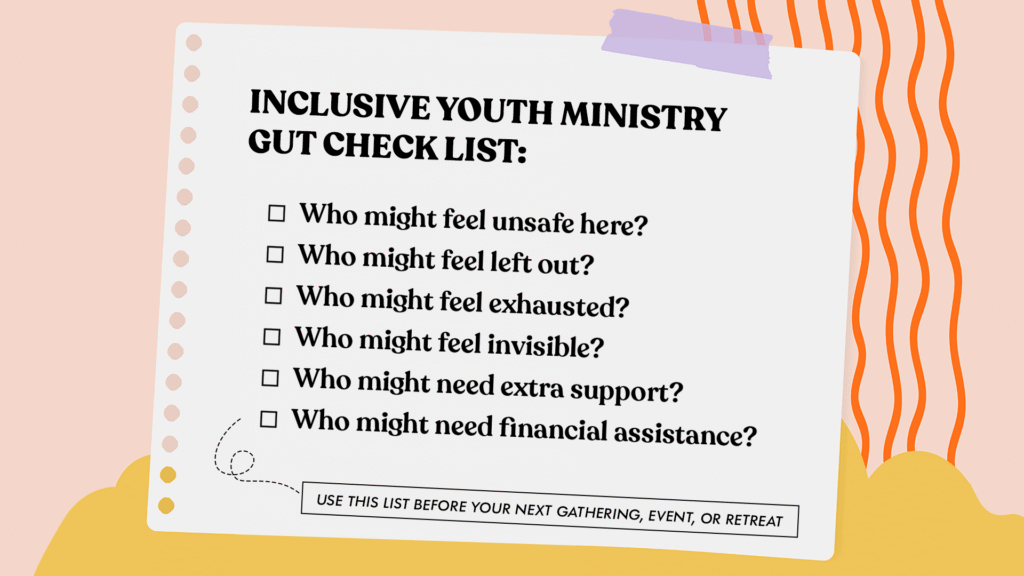
An Inclusive Youth Ministry “Gut Check” List:
- Who might feel unsafe here?
- Who might feel left out?
- Who might feel exhausted?
- Who might feel invisible?
- Who might need extra support?
- Who might need financial assistance?
To help us grow and learn as a community, what is missing from this list of questions and practices? What other “gut check” questions would you add?
Looking for more youth ministry planning ideas? Check out our Youth Ministry Summer Planning Guide for additional tips and strategies.
Want to continue learning about creating more inclusive youth spaces? Check out our three-part series on Welcoming and Affirming Queer Youth: Part One, Part Two, Part Three.
Deborah Jodrey
Guest Contributor
[…] Jodrey at Illustrated Ministry for writing up this fantastic planning checklist for building Inclusive Youth Ministry: Planning with Marginalized Youth in Mind (Illustrated Ministry blog; […]