
GUEST WRITER: SYDNEY HARKRIDER
I live in Evanston, Illinois, just outside of Chicago. I am the Director of Youth and Young Adult Ministries at a Methodist Church. Over the past several years, immigration enforcement (ICE) activity has become a constant topic of conversation across Chicagoland communities and across the country. Immigration enforcement was not just something people saw on the news anymore; it was happening in our neighborhoods. An ICE presence affects how families move through everyday life; it changes routines, creates uncertainty, and brings fear into places that are supposed to feel normal and safe.
For the youth in our churches, this isn’t just a political conversation. It’s personal.
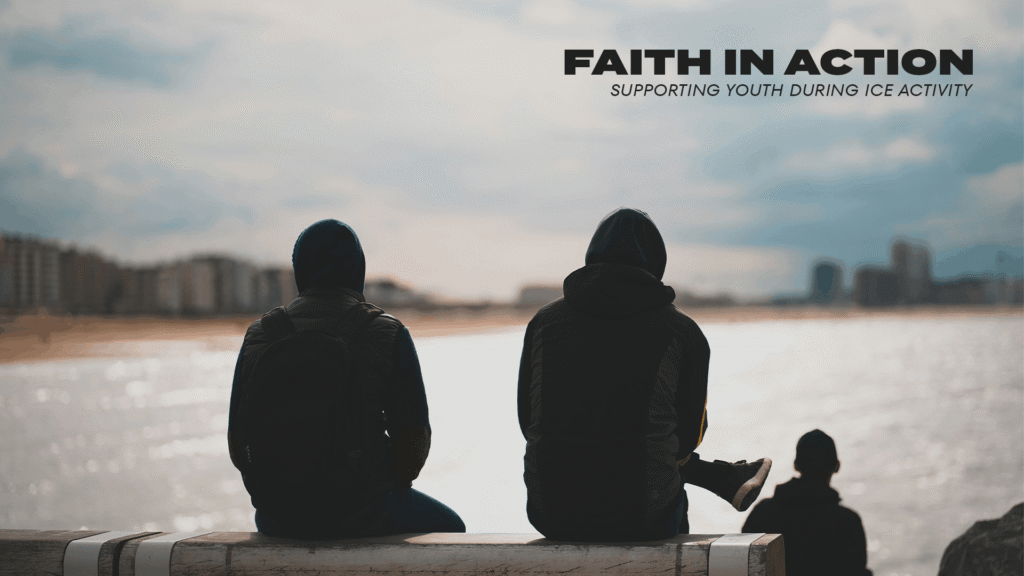
When ICE Activity Becomes Part of Ministry
Typically, you only hear from church members during the week by email, but communication has become more constant for horrific reasons. Our church started a much-needed group chat to alert each other whenever there were needs or immediate dangers in our community.
There are ICE cars parked outside Home Depot.
Helicopters are flying near the schools.
ICE agents are outside the schools during parent pickup.
These conversations became routine.
At the church itself, we designated specific rooms as holding rooms in case we ever needed to house someone trying to hide from ICE.
On Sunday mornings, while bulletins were being passed out for worship, so were whistles and instructions on when to blow the whistle to alert anyone nearby that ICE had been spotted.
A few times, some of us from the church went to protest with other faith communities outside the ICE facility in Broadview, Illinois. I couldn’t stop thinking about how people who look like me were being abused inside those walls. There’s no feeling like watching people scream and sing with their whole body and spirit in the hope our voices could be enough to free those being held captive.
One Sunday afternoon, a student asked me a question that caught me off guard: “I have a Hispanic friend. Are they safe to come to church?”
It took me a moment to fully understand why they were asking.
They weren’t asking theoretically. They genuinely wanted to know whether inviting their friend into our church community could somehow put them at risk.
That moment shifted something for me.
Youth ministry stopped feeling primarily about programs, events, or attendance numbers. It became about presence; about being a trusted adult when the world around students suddenly felt unstable and unpredictable.
Who Is Affected?
Before we discuss how to help youth navigate these realities, it’s important to note that every youth ministry context is different. Some churches may rarely directly encounter these realities. Others are serving students who think about these fears Every. Single. Day.
No matter your context, learning how to respond with wisdom and compassion matters. And if this is already part of your community’s reality, you know how emotionally heavy it can be for students, families, and leaders alike.
This work requires care. It requires listening. It requires being thoughtful about how we show up.
What Students May Be Carrying
Even when students don’t talk about these fears openly, they may still be carrying a lot internally.
- Fear of losing friends
- Anxiety about safety and stability
- Misinformation from social media
- Isolation
As ministry leaders, our job is not to have perfect answers to every situation. Our role is to create spaces where students know they are seen, heard, and cared for.
Preparing Yourself as a Leader
You do not need to become an immigration expert overnight. But it is important to have a basic understanding of immigration practices.
- Learning general “Know Your Rights” information from trusted organizations.
- Identifying local legal or advocacy resources you can refer families to.
- Understanding your church’s policies and boundaries.
- Talking with church leadership before situations arise.
Preparation helps us respond calmly and thoughtfully instead of reacting out of panic or uncertainty. Because eventually, students will ask questions.
When Students Ask Difficult Questions
“Can someone get taken from church?”
“What happens if my family gets stopped?”
“Are we safe here?”
Those are heavy questions. And it’s okay if you do not have every answer immediately.
“I care about your safety.”
“We can look for helpful information together.”
“You’re not alone.”
Students do not need perfect responses. Often, they need grounded adults who remain calm and honest.
Avoid speculation. Avoid fear-driven responses. Stay rooted in care and truth.
Caring for Yourself, Too
This kind of ministry can be emotionally exhausting.
Holding space for fear, uncertainty, and pain takes a toll over time. That’s why leaders also need support and care.
- Process with trusted colleagues or mentors.
- Set healthy emotional boundaries.
- Pray, reflect, and rest regularly.
You cannot pour endlessly into others without refilling yourself along the way.
A Ministry of Presence
When communities are living with fear and uncertainty, youth ministry is more than programming.
It’s about creating consistency when life feels unstable.
It’s about holding space for difficult questions.
It’s about reflecting God’s care through everyday presence.
You may never fully realize the impact you have on a student simply by showing up consistently. But for students navigating fear and uncertainty, trusted adults can become lifelines.

A Final Word
If you are navigating these realities in your ministry context, you are not alone.
Across churches and communities, youth workers are learning how to care well for students amid complex realities. They are adapting and trying their best to lead with both wisdom and compassion.
Whether this is already affecting your community or you are preparing for the possibility that it will one day, your willingness to learn and show up matters.
May your ministry continue to be marked not by fear, but by presence. The kind of presence that reminds students they are not abandoned when life feels uncertain.
They are not alone, and neither are you.
Thanks be to God.
Sydney Harkrider
Guest Contributor
Leave a Reply